

Updated: Feb 25


By Tristan Finazzo
The Sky Is Green, The Tears Are Blue
Light pollution from commercial squid fishing looms over this Taiwanese archipelago, once known for its darkness. But some people are fighting to reclaim the night.
By Tristan Finazzo
Photographs by Chang-Ching Su
From the sea-facing courtyard of his ancestral home, Chen Weijun shared stories of his childhood in the wartime Matsu Islands, nearly 70 years ago. He recalled lying in that same courtyard under pitch black skies, staring up at a blanket of stars, and listening to the whispers of soldiers sent from Taipei. As far back as he could remember, Matus’s fishing communities had spent their nights in total darkness.
This darkness was no accident. Chen was born during the Chinese Civil War, when Taiwan claimed the Matsu Islands as its territorial frontline and enforced a sundown curfew across the islands. To avoid rocket fire from mainland China, just nine miles across the channel, residents were banned from using any forms of light that could expose their position in the open ocean.
Chen and his family slept under martial law and mandatory dark skies for more than 40 years, until the ban on light was lifted in 1992. And while the pristine night let Matsu’s nocturnal ecosystems thrive, generations of residents came to associate darkness with the looming threat of invasion.
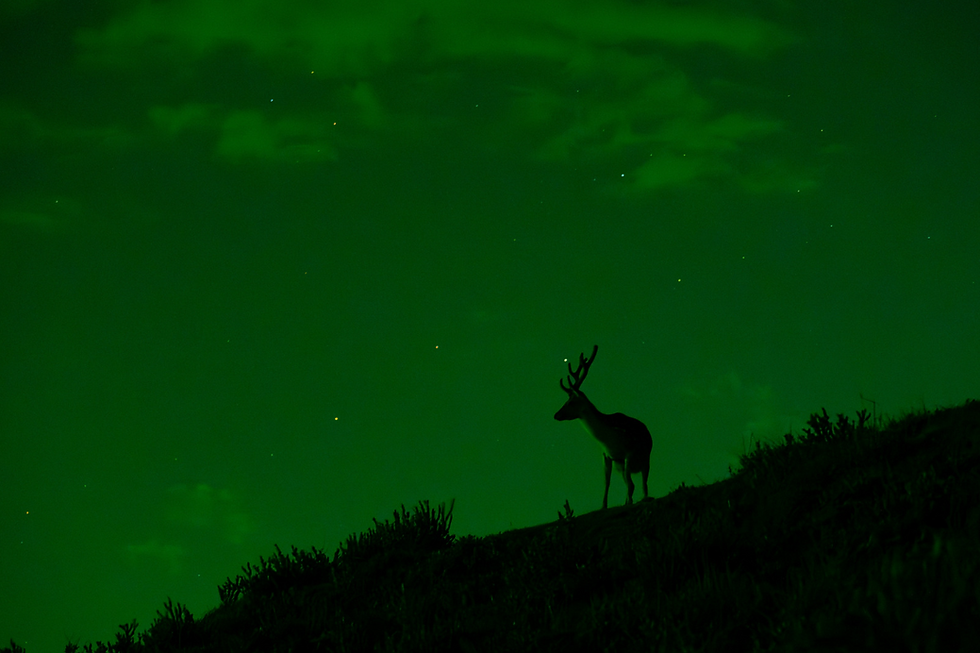
Today, however, an excess of light haunts the islands. The threat of war has waned, but the night sky now smolders green with light pollution. Ever since a fleet of squid fishermen with high-powered lure lights arrived, the stars of Chen’s youth have been replaced by a constellation of ships ablaze in the bay.
—
Out of Darkness
The Matsu Islands once enjoyed the freedom of anonymity in the Taiwan Strait.
Long ago, fishermen from China’s coastal Fujian Province migrated out to the small archipelago, where the fish and squid were bountiful. There, they formed communities without national allegiances and quietly prospered beyond the bounds of empire.
But the civil war eventually brought combat to Matsu’s quiet shores, dispossessing the islands of their natural heritage, and darkness was its accomplice.
Because of their proximity to the mainland, the Matsu Islands were easy targets for artillery fire, and the Taiwanese military imposed measures to minimize the vulnerability of their newly claimed territory. In addition to banning the use of light at night, martial law declared fishing in open waters ‘too visible.’
Local fishermen were seen as threats to national security and forced to renounce their professions in temples before the goddess Mazu:
“Should I ever bring home another catch, may my boat overturn, and may I die at sea.”
But the long-time anglers of Matsu knew its waters better than any military men from abroad. They often sailed out to blind spots in the channel and consorted with their counterparts from China—fishermen with whom they shared not a common flag, but a common trade and a kindred tie to Fujian.
Hailing from a long line of Matsu fishermen, Chen Weijun has reclaimed his childhood home and refashioned it as Qinbi Wanghailou, the “Sea-Facing Building of Qinbi Village”, where he now manages a traditional homestay on the northern island of Beigan.
Now in his early seventies, Chen is known universally to the island’s few thousand residents as Laoban, or “Boss,” and his endless tales of life as a swimmer, paratrooper, businessman, marathoner, and innkeeper attest a life of hardy thrills and perspicacity.
But where the Milky Way once crossed overhead, a cataract of light now pollutes the night sky of Chen’s youth.
“The sky used to be full of stars,” he lamented over a table filled with dried fish jerky and homemade rice wine. “It was never like this before…”
More than half a century ago, the Matsu Islands were caught in the crossfire of warring nations and deprived of light. Today, however, a new outside force is robbing them of darkness.
As soon as China’s summer moratorium on inland fishing takes effect, ships rigged with green LED lights pour out from mainland ports and trawl the channel in search of mitre squid. Known locally as xiaojuan, or “little rolls,” these small white cephalopods are drawn to the specific wavelength of light used by the fishermen.
Long metal rods extend from the ships like spider legs, dangling rows of green lanterns and nets that extract up to 26 tonnes of squid per day.
“This place used to have some of the best fishing in the world too.” Chen recounted how the Bay of Matsu once brimmed with yellowfin seabream. But, in recent decades, a frenzy of ships has increasingly occupied the extralegal “gray zone” between the borders of China and Taiwan.
He sat staring out at the bay aglow with green.
“For every 10,000 fish you’d see then, now you see only one.”
Now the squid are all that remain in large supply, and the once-familiar sea and sky have become unrecognizable to the Matsu fishermen of old.
The wartime ban on light was lifted more than thirty years ago, but the islands now live with its agonizing overabundance. Instead of courtyards under the Milky Way, the children of the Matsu Islands now fall asleep in the incandescent glow of a thousand humming ships.
They believe the night sky has always been this way. In their few years of adolescence, they’ve never known it to be anything but green.

—
A War of Dark and Light
Light pollution is an insidious form of environmental destruction and a seldom considered consequence of the modern age. As a daytime species, humans naturally equate light with safety and prosperity. But excessive light at night can devastate circadian rhythms and mental health.
Other species are often even more dependent on darkness, and bright light at unnatural hours can disrupt critical elements of survival like migration patterns, habitat formation, mating cycles, and resistance to disease.
Research from DarkSky International (formerly the International Dark-Sky Association) revealed a 49 percent increase in global light pollution over the last 25 years due to artificial sources like mass urbanization and 24-hour advertisement. Founded in Tucson, Arizona in 1988, its mission of raising awareness about the value of dark skies has spread to 70 countries, with its Taiwan chapter facing perhaps the most extraordinary set of historical and environmental challenges.
The skyglow that haunts Matsu is unlike anywhere else. Along with the greed for profit and anthropocentric technologies typically associated with light pollution, the “Matsu aurora,” as locals now call it, hangs over an archipelago whose identity is fundamentally rooted in its relationship with light.
With a total area of just over 11 square miles, the Matsu Islands are home to immense biodiversity. Nocturnal cobras and orbweaver spiders prowl the shadows, and rare Sika deer graze between patches of evergreen forest.
But Matsu residents agree that its true treasure is its bioluminescence.
Tucked away in thick grasses and scattered meadows, the springtails, glowworms, and flightless lightning bugs are Matsu’s terrestrial night lights. Along the coast, jumping shrimp and toothed sea fireflies glimmer in the shallow tide, while bioluminescent plankton that glow in moving water, dubbed “Blue Tears,” whirl in the waves at sea.
Blue Tears have long been the pride of the Matsu Islands and a staple of its ecotourism economy. Marketing campaigns have called visitors from around the world to experience their magical bloom, and photos of the islands are seldom without a ghostly blue contour.
In sufficient darkness, the beaches of Matsu alight, and streaks of sapphire can be seen chasing the tide like comets in the sand.
Although Matsu’s artificial lights were suppressed for 42 years, the war could do little to extinguish its natural illumination. By the time martial law was repealed in 1992, Blue Tears flourished in every cove, and the islands’ forests teemed with nocturnal creatures that had grown accustomed to unspoiled night.
People emerged and explored their home beneath the stars for the first time to find decades of pristine and unfamiliar wonders. A new species of less than 200 fireflies was discovered in the mountain glades of Beigan, and the Blue Tears that had once betrayed the positions of nighttime fishermen to the enemy were reclaimed as a natural wonder of the Matsu Islands.
But the path to prosperity in the modern age was lined with street lamps and billboards, and the wildlife that had come to rule the night was soon subdued by waves of builders and bright-eyed travelers.
After martial law was lifted, a “democratic era” brought government compensation for Matsu’s wartime hardships. Streetlights were erected en masse, and where darkness had dominated for generations, electricity consumption soared to more than three times Taiwan’s national average to support Matsu’s tourism economy.
Matsu responded to decades of darkness with an abundance of artificial light, believing it would bring progress and stability. But just as light pollution from growing urbanization began to emerge, the “green ships” arrived, and the islands with decades of wartime trauma tied to darkness were suddenly overflowing with light.
The number of squid fishing operations has only grown in recent years. Chen estimated a thousand or more ships occupy the channel at peak season.
Their broad spectrum LED light engulfs the natural glow of Matsu’s Blue Tears, and with near-zero genetic diversity among its vulnerable populations of fireflies, even minor changes to their habitat could drive them to extinction in the coming years.
In the supernatural green light of the Matsu aurora, the islands have been confronted with an impossible choice: the devastation of a wilderness they only just reclaimed or a deliberate retreat to the darkness that, for generations, deprived them of home.

—
Taking Back the Night
After decades of occupation by Taiwanese forces, the military economy that had sustained life in the Matsu Islands was abandoned, leaving a vacuum that its 12,000 residents have fought to fill. The bountiful waters around Matsu have been severely depleted by overfishing, and exporting what remains back to Taiwan, more than one hundred twenty-five miles across the Strait, is largely unprofitable.
Trade with mainland China and tourism remain as economic lifelines for the islands, and with nominal ties to the Taiwanese government, Matsu’s economy has been kept alive by the will of local people for the last thirty years. As a result, environmental stewardship has become the responsibility of outsiders with both the concern and capability to act.
Five years ago, the Taiwan Dark-Sky Association (TDA) made strides toward filling this role by volunteering to help Matsu reframe its relationship with darkness.
Inspired by the work of DarkSky International, TDA was founded in 2019, when a cohort of scientists and activists noticed an increasingly severe skyglow over urban areas in Taiwan. Later that year, they nominated Matsu’s once-inhabited islet of Daqiu to DarkSky International for candidacy as a dark sky preserve.
Dark sky preserves are naturally dark places with specific lighting protocols that regulate the presence of light pollution. TDA proposed Daqiu as a site for the promotion of dark sky tourism in an effort to conserve the starry skies and nocturnal life that had characterized the Matsu Islands for generations. The preserve would also serve as a draw for ecotourism, and the local government was convinced by its potential to help support Matsu’s economy.
In Taiwan, the Matsu Islands are known for their isolation. When typhoons make landfall in July, dense fog can hang like cotton over their sea-level runways, prohibiting the passage of tourists, residents, and supply ships for weeks. In the eyes of TDA, Daqiu was a natural candidate for dark sky preservation.
What the group did not foresee was the surge in green light squid fishing just months after their proposal. Fishing with LED lure lights has been practiced since the early 2000s, but green LEDs only exploded in popularity after becoming widely available in Southeast Asia in the late 2010s.
Green light attracts more bait fish than any other color. Compared with the once-dominant white LEDs, the lower frequency of green lights was also purported to reduce “bycatch,” or the amount of non-target species pulled up in the nets. Its light-polluting effects, however, went unassessed until it was too late.
At the outset of the 2020 squid fishing season, shortly after TDA arrived in Matsu, an explosion in the use of green lure lights ignited the sky over Matsu.
“Of course [Matsu residents] don’t like the green lights,” said Zhou Xiaoma, a Nangan native and Matsu’s preeminent tourism photographer. “The light affects all things in Matsu, including my photography.”
Residents like Zhou feel uneasy carrying on under the green glow each night, but the solution is daunting and complex, and people must prioritize their livelihoods.
“If the stars came back, they could become a selling point for ecotourism,” Zhou said. “But light pollution is a great injury to the night sky, and China and Taiwan are too at odds. We have no means to cooperate.”
Just outside Taiwanese waters, the predominantly Chinese squid fishermen are untouchable by Matsu local officials or TDA. Only communication between the governments of Taiwan and China could hope to affect change, and light pollution is eclipsed by the endless list of geopolitical disputes that dominate discourse.
“It’s become an unwinnable fight,” said Axiou Lin, co-founder and chairman of TDA. As long as the green light remains, the skies over Daqiu Island will never be dark enough for certification as a dark sky preserve.
Despite its striking effects, light pollution is easy to overlook and difficult to address. It almost always derives from sources we associate with progress and productivity, and the adverse health effects of artificial light at night are not immediate, nor easily felt, but gradual and psychological.
In addition, the green light caused by unregulated squid fishing thrives in the blind spots of international awareness and national jurisdiction. Fishermen evade oversight in the gray zone waters beyond the borders of China and Taiwan, and their ill-defined liability makes it difficult for Matsu to call upon the mainland for a solution.
Elevating the problem of unregulated fishing in the international dialogue requires not a single incident, but a cascade of political action beginning at the grassroots level.
Concerned Matsu residents and organizations like TDA represent initial steps in this direction. They believe only the pressure of public outcry and unfavorable visibility can move the responsible nations to address the root causes of light pollution.
“Every party is a loser in this prisoner’s dilemma,” Axiou said. “Fishermen damage their eyes, ship owners overspend on gasoline, and consumers are unaware that they are participating in the destruction of ocean ecology.”
All the while, Matsu’s endangered species seek refuge in the disappearing shadows. Far from the spotlight of public discussion, they fight in vain with the green light.

—
A Window to the Stars
Late last August, veteran astronomer Li Qixin led me through the lightless, web-laced footpaths of Daqiu Island on a quest to quantify its darkness.
As co-founder of TDA, he was tasked with conducting a “lighting audit”—measuring the brightness of the sky from open vantages around Daqiu— for evaluation by DarkSky International.
Cicadas rumbled all around us as Li led the way through the forest. Periodically, he raised a handheld measuring device toward the night sky and captured its magnitude per arcsecond with the press of a button.
With the glow of the full moon and our scarlet headlamps, the reading on Li’s digital meter was faint but visible: 19.6 at worst, 20.9 at best. The “dark sky” over Daqiu hovered somewhere between “typical suburban” and “bright rural” on the Bortle scale, the international standard for measuring the brightness of the night sky.
On the other side of the island, a congregation of two hundred was spread out across its grassy summit, serenaded by a group of zitherists from Taipei. They had convened under a handful of pale stars for the annual Daqiu Dark Sky Night.
Each year since 2019, TDA has called conservationists, musicians, artists, and Matsu locals to gather atop the islet in support of its fight against light pollution and in defiance of the goliath fleet of squid ships hovering in the bay below.
By the time Li and I arrived, the music had come to a lull. Murmurs in the audience were hushed as Li pulled out a laser pointer and took to a podium before the crowd.
“Sometimes, when we turn down the lights, things become more visible.” His voice projected up toward the stars. “And tonight, you’re all very lucky.”
Two hundred heads tilted back, mouths agape, as Li aimed his laser upward. A faint band of stardust could be seen cutting across the sky.
Despite the green light, Daqiu remains one of the darkest places in the Matsu Islands. And the sounds of amazement that evening suggested it was the first time many residents had laid eyes on the Milky Way.
Later that night, Li and I took shelter from a fierce summer squall in a fluorescent 7-Eleven back on Beigan.
“Matsu’s elementary school children are unaccustomed to a normal night sky,” he sighed as we sat in the front window, staring out at the storm. “And it’s uncanny for us, their parents’ generation, who grew up when the night sky was always dark.”
Now the Director of the Kaohsiung Astronomical Society, Li recalled a time before the green lights when the night was full of natural wonders, ripe for observation.
“But tonight might have been the last Daqiu Dark-Sky Night,” he admitted as the skies outside began to clear.
He was right.
Government funding for the project halted not long after the event, and worsening cross-strait relations continue to push issues of light pollution and fishing regulation further down on the diplomatic agenda. This past year, TDA was forced to abandon its Daqiu Dark
Sky project altogether.
Yet, even without the formal recognition of Daqiu as a dark sky preserve, TDA has been planting the seeds of dark sky conservation in the Matsu Islands for years.
Working out of Matsu’s oldest military high school, a single-story row of white stone classrooms that bakes in the Nangan sun, Huang Kaiyang has been a tireless advocate for the people of Matsu his entire career.
Before founding the Matsu Youth Development Association, where he now helps young Matsunese professionals connect with the culture of older generations, Huang served as TDA’s first liaison to the Matsu Islands. He drafted a 400-page proposal for dark sky conservation on Daqiu Island and successfully lobbied Matsu’s county leadership to pass the nation’s first piece of legislation for controlling light pollution.
Developed in coordination with Matsu’s Environmental Resource Bureau, the light pollution ordinance recognized the “impact of the Matsu aurora on the lives of local people,” Huang recalled. But its primary focus was on creating policies to address light pollution from sources within the Matsu Islands, where the jurisdiction of the county government is unambiguous.
It enabled the creation of “light-sensitive areas” to protect the islands’ Blue Tears and rare fireflies and banned development on outlying islands, where light pollution disrupts the migration of Matsu’s critically endangered crested terns. Upper limits were placed on the brightness of street lights, roadside advertising was restricted, and fines were imposed for violating limits on artificial light.
Despite acting in the interest of the islands’ environment, however, government-enforced restrictions on light occupy an unsettling place in the memory of Matsu natives.
“Up until 1992, the concept of ‘dark skies’ was a kind of trauma for the people of Matsu,” Huang explained. But in 2020, when a rare species of flightless fireflies reappeared in the grass beside a hostel on Beigan, local people started to consider the protective value of dark skies.
“When the fireflies returned, so did people’s childhood memories,” he said. “This is how the dark sky concept began to appeal to people’s identity.”
For some, trauma from the wartime ban on light was overcome by memories of Matsu’s natural beauty. Others recognized the ecotourism value of its bioluminescent wonders. In either case, residents of the Matsu Islands began to consider a willful return to darkness.

—
Defending Darkness
On my last night in Matsu, I sat at a lacquered wooden table in the courtyard of the Sea-Facing Building of Qinbi Village, staring out across the channel. Inside his childhood home, Laoban prepared a feast of dried squid, sea bream, fish noodles, and other delicacies fresh from the sea.
With a full pipe and a bottomless supply of rice wine, he regaled me with stories of his past lives in the light of the Matsu aurora; stories of the ‘mythical terns’ he had ventured to see on the faraway island of Liangdao; of the arrival of electric lights; and of the 50,000 soldiers who had once occupied Matsu during the war, and the 3,000 that remain in reserve.
He spoke of a legend that has endured since the time of Matsu’s earliest inhabitants—
It was said that, during the Song Dynasty, a fisherman’s daughter named Lin Moniang was consumed by the vengeful seas. Overcome by devotion, she swam into the monsoon in search of her lost father and, having succumbed to exhaustion, her body later reached land on the shores of Nangan. Moved by her piety, villagers built a grand temple in honor of Moniang, and she was resurrected as the Mother Ancestor (Mazu), protector of fishermen, and the namesake of her descendants’ home.
Today, the Cold War has thawed in the fever of globalization, and many of the fishing families once displaced from Matsu have returned and laid down roots. Instead of mountaintop military men, a 100-foot statue of Mazu now towers over Nangan, protecting her island communities.
But each night, the Mother Ancestor is met by an armada of squid fishermen that dominate the sea and sky. And each night, the light grows. The dark cannot be protected if it is nowhere to be found, and where martial law once commanded 42 years of darkness, the light is now boundless at all hours of the night.
TDA’s effort to curb artificial light in the Matsu Islands was a Herculean ambition, and the global epidemic of light pollution is even more daunting. The fate of the night now rests on the cooperation of historically warring nations, raising awareness about a problem most people see as a solution, and protecting the parts of our world that stand to lose the most.
But night is immortal in this place. Despite the whir of ships in the bay, the cicadas rumble in the distance, and Blue Tears still fill the scattered shadows. Even in exile, the stars are fighting their way back.